



Stucco Repair in Tempe, AZ

Crack repair, color-coat, and full resurfacing across Tempe.

Serving Tempe & nearby Maricopa County

Get Your Free Stucco Repair Estimate

Step 1 of 5Project

What kind of project?

Pick the option that fits best — you can add details next.

Quick Answer

ProWorx Restoration provides stucco repair across Tempe, AZ — pre-1980 three-coat hard-coat patching, ASU rental-turn re-coats, foundation step cracks, and water-intrusion repair in Maple-Ash, Tempe Gardens, and Warner Ranch. Typical projects run $500 – $8,000.

1,200+

Projects Completed

15+

Years Experience

ROC #349454

Licensed & Insured

100%

Satisfaction Guaranteed

Stucco Repair Built for Tempe Homes
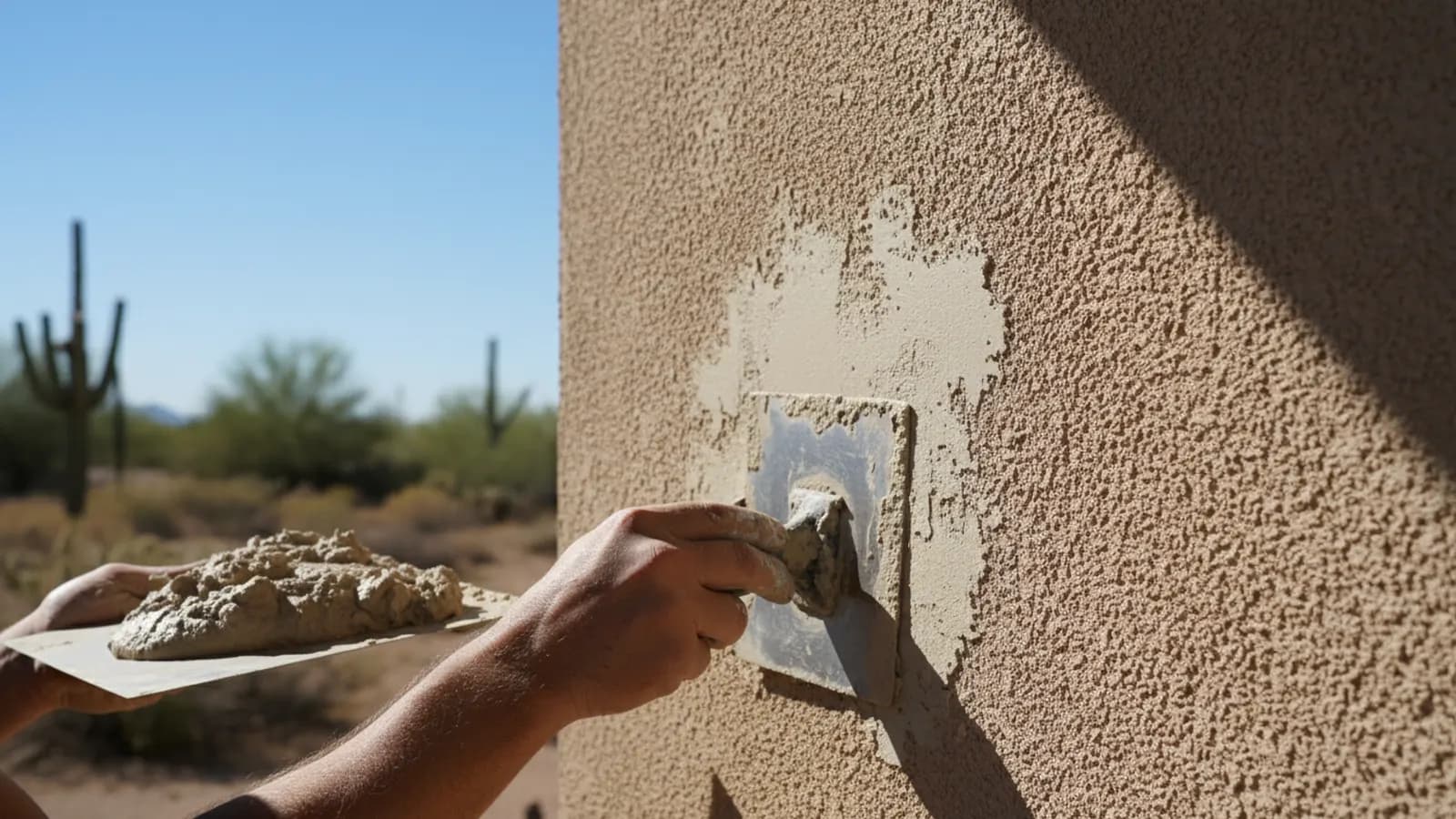
Stucco patch being floated over a repaired wall section and the texture matched in a Tempe, Arizona home
Tempe's housing is older than most Valley cities — Maple-Ash, Tempe Gardens, and University Park are 1950s–70s three-coat hard-coat over wood or wire lath, and our most common scope is period-correct lath repair, dash / lace finish match, and color blending.
ASU-area rentals drive fast-turn re-coat work between tenants; we schedule around lease cycles.
Newer Warner Ranch and The Lakes use synthetic systems with different repair approach.

Why Tempe Stucco Repair Is Different

Pre-1980 three-coat hard-coat over wood / wire lath: Maple-Ash, Tempe Gardens, University Park.
ASU rental-turn scheduling: between-lease re-coats.
Warner Ranch / The Lakes synthetic system repair.

Recent Stucco Repair Projects in Tempe

Maple-Ash

1965 ranch lath patching, dash finish match, integral color blend

$5K5 days

University Park

ASU duplex full re-coat 1,400 sf between leases, fog coat

$6.5K5 days

Warner Ranch

Synthetic patch + color blend 4 locations, mesh repair

$3K3 days

Stucco Repair in Tempe: Fast Facts

Pre-1980 three-coat hard-coat: ~50% of Tempe volume.

ASU rental-turn work: ~25%.

Foundation / water-intrusion: ~15%.

Average Tempe stucco repair: $1,500–$7,000.

Period-correct dash / lace finish: specialty.

Typical Cost

$500 – $15,000+

Typical Timeline

2 days – 2 weeks

Permit Lead Time

2–4 weeks

How We Approach Stucco Repair

Arizona's extreme heat, monsoon-driven wind-driven rain, and 40°F+ daily thermal swings put stucco under constant stress. ProWorx Restoration repairs hairline and structural cracks, patches damaged areas, performs full re-stucco on aged exteriors, and matches color and texture across Phoenix-metro homes and commercial properties. Arizona ROC #349454.
Stucco failure modes in the Valley fall into predictable patterns. Hairline pattern cracking on south and west elevations from UV and thermal cycling. Diagonal cracks at window and door corners from minor structural movement. Bulging or hollow-sounding patches where moisture penetrated past failed sealant joints. EIFS (synthetic stucco) delamination on 1990s–2000s tract homes where weep details were undersized. We identify the failure mode before patching so the repair lasts.

Hairline and structural crack repair with elastomeric or cementitious patch

Full-wall and whole-house re-stucco (traditional three-coat)

Color matching from samples; integral and elastomeric topcoats

Texture matching: smooth, sand, dash, lace, Santa Barbara, Spanish

Window and door sealant replacement at stucco interfaces

EIFS repair and weep-detail correction

What Tempe Homeowners Should Know About Stucco Repair

Foundations and Soil Movement

Some areas of Arizona have expansive clay soils that swell when wet and shrink as they dry, which can cause foundations to move and walls to crack. Poor drainage around a building makes this worse. Restoration may involve repairing cracks, improving drainage so water is directed away from the foundation and, in more serious cases, structural foundation repairs designed by an engineer.

Inspecting Stucco Regularly

Walking around the house once or twice a year to look for new cracks, staining, efflorescence and damaged areas allows stucco problems to be addressed early, before water causes hidden damage behind the wall.

Repointing Mortar Joints

Mortar joints deteriorate over time, becoming cracked, crumbly or recessed. Repointing removes deteriorated mortar to a consistent depth and replaces it with fresh mortar, restoring the joint's strength and weather resistance. The new mortar should be compatible with the existing masonry, and matching colour and joint profile helps the repair blend in.

Sealing Masonry

Breathable masonry sealers can help reduce water absorption while allowing moisture inside the wall to escape. Sealers are not appropriate for every situation, and non-breathable coatings can trap moisture and cause damage. Choosing the right product depends on the type of masonry and its exposure.

Pool Barrier Walls

Block walls frequently serve as pool barriers, and gaps, damage or climbable features can compromise safety. Repairs should maintain the required barrier height and integrity. Pool barrier requirements vary by jurisdiction, so any changes should be checked against local rules.

Masonry Fireplaces and Chimneys

Masonry fireplaces and chimneys can develop cracked mortar, damaged crowns and deteriorated flues. Since these components affect fire safety, they should be inspected regularly and repaired by professionals. Restoring chimney crowns and mortar joints keeps water out and protects the structure.

Working With Engineers and Architects

Significant restoration projects often involve structural engineers, architects and, for historic buildings, preservation specialists. Coordinating their recommendations with practical construction methods ensures repairs are technically sound, compliant with codes and achievable within the budget. Early collaboration between designers and the contractor helps identify the most effective restoration approach.

Materials & Standards We Use

Three-coat stucco per ASTM C926 and ASTM C1063 (lath). Color coats are acrylic-modified for UV durability or integral-color cement for traditional look. Elastomeric topcoats meet ASTM D6083 for crack bridging on hairline-cracked walls. Sealants at stucco-to-window and stucco-to-trim joints are polyurethane or hybrid (Sikaflex, OSI Quad), not silicone. Weep screeds and casing bead per ASTM C1063. All work warrantied under ROC #349454.

Reading Stucco Cracks

Not all stucco cracks mean the same thing. Fine, hairline cracks in a random pattern are usually shrinkage cracks from the curing process and are mostly cosmetic. Cracks radiating from the corners of windows and doors often reflect normal movement concentrated at those weak points. Wider cracks, cracks that keep growing, or cracks with one side higher than the other may indicate structural movement and warrant closer inspection. Understanding the type of crack guides the right repair.

Common Stucco Issues in Phoenix-Metro Homes

Four issues drive most calls. First, south and west elevation pattern cracking from UV and 40°F daily thermal cycling. Second, diagonal corner cracks at windows and doors from minor frame movement and missing diagonal lath reinforcement. Third, monsoon-driven moisture intrusion at failed sealant joints around windows, hose bibs, and electrical penetrations — water gets behind stucco and rots sheathing. Fourth, on 1990s–2000s tract homes, undersized or missing weep screeds at the foundation that trap moisture. We address the root cause, not just the visible crack.

When to Re-Stucco Entirely

If stucco is extensively cracked, delaminated or water-damaged across large areas, re-stuccoing the wall may be more cost-effective than repeated patching. Replacement also allows inspection and repair of the water-resistive barrier, lath and substrate beneath.

Code Requirements During Restoration

Restoration work may trigger requirements to bring parts of the building up to current codes, particularly when the building's use changes or major alterations are made. Accessibility, fire and life safety, electrical and energy requirements can all apply. Understanding these requirements early prevents surprises during permitting.

Efflorescence on Stucco

A white, powdery deposit on stucco is called efflorescence. It occurs when water moves through the material and leaves dissolved salts on the surface as it evaporates. Efflorescence itself is mostly cosmetic, but it signals that moisture is moving through the wall, and the source of that moisture should be investigated.

Restoring Occupied Buildings

Many buildings must remain in use while restoration takes place. Phasing work, scheduling noisy tasks outside business hours, maintaining safe access, protecting occupants from dust and keeping essential systems operating all require careful planning. Clear communication with occupants reduces disruption.

Our Proven Process

01

Free Consultation

We visit your property, discuss your goals, and provide a detailed, no-obligation estimate.

02

Custom Plan

Our team creates a tailored project plan with timeline, materials, and transparent pricing.

03

Expert Execution

Licensed craftsmen complete your project with quality materials and meticulous attention to detail.

04

Final Walkthrough

We inspect every detail with you and ensure complete satisfaction before the job is done.

"ProWorx turned our ASU duplex re-coat in five days between tenants and matched the original 1968 dash finish on the next-door house perfectly."

ProWorx Client · Tempe

Neighborhoods We Serve in Tempe

Maple-Ash · Tempe Gardens · University Park · Warner Ranch · The Lakes · Lakes Estates · Mitchell Park · Hudson Manor

Stucco Repair FAQs for Tempe Homeowners

Ready to Start Your Tempe Stucco Repair Project?

Get a free, no-obligation estimate from a licensed Arizona contractor — ROC #349454.