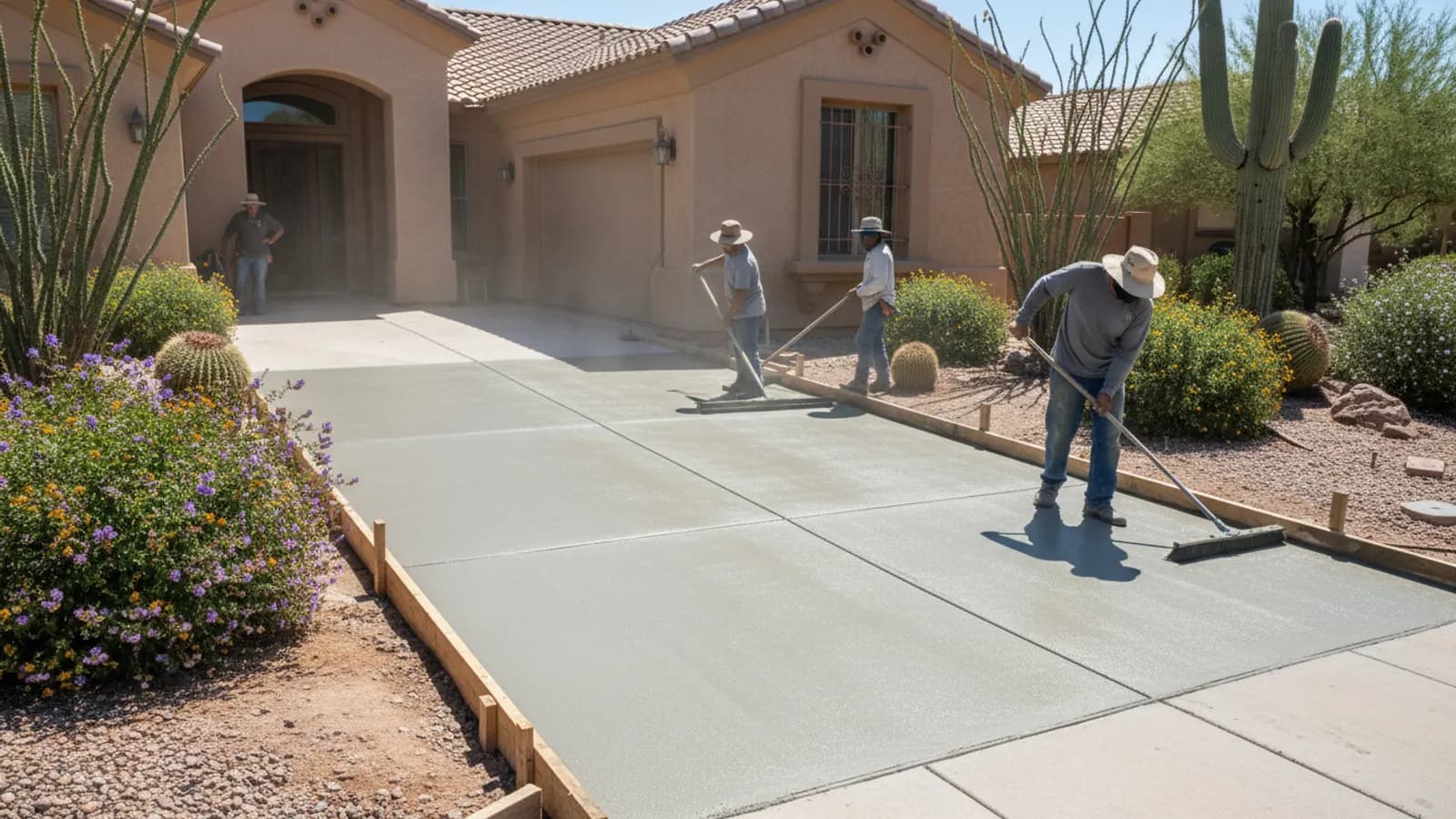
Our Concrete Pouring Process in Arizona
Every pour starts with subgrade prep — strip topsoil, compact to 95% Proctor, and place a 4" aggregate base course for driveways and slabs. Forms are set to grade with proper slope for drainage (1/4" per foot minimum on patios). Reinforcement: #4 rebar on 18" centers for driveways, welded wire mesh for patios. Concrete spec: 3,000 psi minimum residential, 3,500–4,000 psi for driveways and structural slabs, Type II low-alkali cement, 4–6% air entrainment. Hot-weather pours use chilled water, retarding admixture, and 4–6 AM placement. Curing follows ACI 308 — wet cure for 7 days or apply ASTM C309 curing compound. Saw-cut control joints within 8–12 hours of placement at 24× slab thickness spacing.
Common Concrete Issues in Phoenix-Metro Properties
Three failure modes dominate. Plastic shrinkage cracking from hot-weather flash-curing — surface cracks visible within hours of placement, prevented by retarders, evaporation reducers, and proper curing. Random cracking from missing or late control joints — saw-cut joints must be placed within 8–12 hours and at 24× slab thickness (so 8 feet OC on a 4" slab). And heaving on expansive clay soils in north Scottsdale and Cave Creek — solved with proper subgrade prep, capillary breaks, and isolation from existing structures. We design around all three; we don't react to them after the pour.
Materials & Standards We Use
Concrete per ASTM C94 ready-mix delivery, 3,000–4,000 psi as scope warrants. Type II low-alkali cement standard for Arizona sulfate-rich soils. Reinforcement per ACI 318 — #4 rebar for driveways and structural slabs, welded wire mesh for patios. Hot-weather pour procedures per ACI 305. Curing per ACI 308. Control joints per ACI 224 spacing rules. Decorative integral colors from Davis Colors or Solomon. All work permitted where required and warrantied under ROC #349454 for material and workmanship.
Pouring Concrete in Arizona Heat
Arizona's heat creates particular challenges for concrete. High temperatures, low humidity and wind cause water to evaporate quickly from fresh concrete, which can lead to rapid setting, surface cracking and reduced strength. Pouring early in the morning, keeping materials cool, using appropriate admixtures and protecting the surface from rapid drying help produce durable concrete in hot conditions.
Why Curing Matters
Concrete continues to gain strength for weeks after it is placed, but only if it retains enough moisture to cure properly. Keeping the surface moist, using curing compounds or covering the slab helps prevent premature drying. Proper curing reduces cracking and improves strength and durability, which is especially important in Arizona's dry climate.
Preparing the Subgrade
The ground beneath concrete must be properly prepared to support the slab evenly. Removing organic material, compacting soil and adding a suitable base layer help prevent settlement and cracking. Poorly prepared ground is one of the most common causes of concrete failure, regardless of how well the concrete itself is placed.
Control Joints and Cracking
Concrete naturally shrinks as it cures, and some cracking is normal. Control joints, which are deliberately placed grooves, encourage cracks to form in straight lines at predetermined locations rather than randomly across the surface. Correct spacing and depth of control joints help concrete crack in a controlled, less noticeable way.
Reinforcement Options
Steel reinforcing bar, wire mesh and fibres can be added to concrete to improve its performance. Reinforcement helps hold cracks together and increases resistance to loads, which is particularly important for driveways and slabs that support vehicles. The right reinforcement depends on the slab's purpose and thickness.
Choosing the Right Thickness
Slab thickness depends on its use. Walkways and patios carry relatively light loads, while driveways and RV pads must support vehicles and require thicker concrete and appropriate reinforcement. Using the correct thickness prevents premature cracking and failure.
Broom, Exposed Aggregate and Stamped Finishes
Concrete surfaces can be finished in many ways. A broom finish provides traction and is common for driveways and walkways. Exposed aggregate reveals decorative stones within the concrete. Stamped concrete imitates stone, brick or tile. Finish selection affects appearance, slip resistance and maintenance.
Sealing Concrete
Applying a sealer helps protect concrete from stains, moisture and wear, and can enhance decorative finishes. Sealers need periodic reapplication, especially on surfaces exposed to intense sun and traffic. Choosing a sealer appropriate for the finish and exposure helps maintain the concrete's appearance.
Driveways
A concrete driveway must withstand vehicle loads, heat and occasional heavy rain. Proper subgrade preparation, adequate thickness, reinforcement, control joints and drainage away from the house all contribute to a driveway that lasts for decades.
RV Pads and Side-Yard Slabs
Many Arizona homeowners add concrete pads beside their homes for RVs, boats or extra parking. These slabs need to support heavy loads, so they require proper thickness and reinforcement. HOA rules and setbacks may also affect where RV pads can be located and how they must be screened.
Drainage Around Concrete
Concrete should slope to direct water away from the house and avoid pooling. Patios and walkways that slope toward the foundation can send water against the home during storms. Planning drainage carefully protects both the concrete and the structure.
Repairing Versus Replacing Concrete
Minor cracks and surface wear can sometimes be repaired or resurfaced, but slabs with significant settlement, heaving or extensive cracking may need replacement. Evaluating the cause of damage determines whether repair will last.
Patios and Outdoor Living Slabs
Concrete patios extend usable living space into the backyard, and they are among the most popular concrete projects in Arizona. A patio should be sized for the furniture and activities planned, sloped to drain away from the house and finished with a surface that is comfortable and safe underfoot. Lighter-coloured finishes stay cooler in direct sun than dark surfaces, which matters in Arizona summers. Planning for future shade structures, lighting or outdoor kitchens before pouring allows footings and conduit to be included.
Scheduling Around Weather
Concrete work is affected by weather, particularly extreme heat and monsoon rain. Pours are typically scheduled early in the day during summer, and heavy rain soon after placement can damage the surface. Flexible scheduling helps ensure the best possible result.