



Commercial Construction in Tempe, AZ

Mill Avenue, ASU-adjacent, and Town Lake commercial construction across Tempe.

Serving Tempe & nearby Maricopa County

Get Your Free Commercial Construction Estimate

Step 1 of 5Project

What kind of project?

Pick the option that fits best — you can add details next.

Quick Answer: Commercial Construction in Tempe

ProWorx Restoration delivers commercial construction across Tempe, AZ — Mill Avenue restaurant and retail TIs, ASU-adjacent office and research-lab support, and Town Lake mid-rise office TIs. Typical TIs $100K–$700K; ground-up $400K–$3M; 9–40 weeks.

1,200+

Projects Completed

15+

Years Experience

ROC #349454

Licensed & Insured

100%

Satisfaction Guaranteed

Commercial Construction Built for Tempe Homes
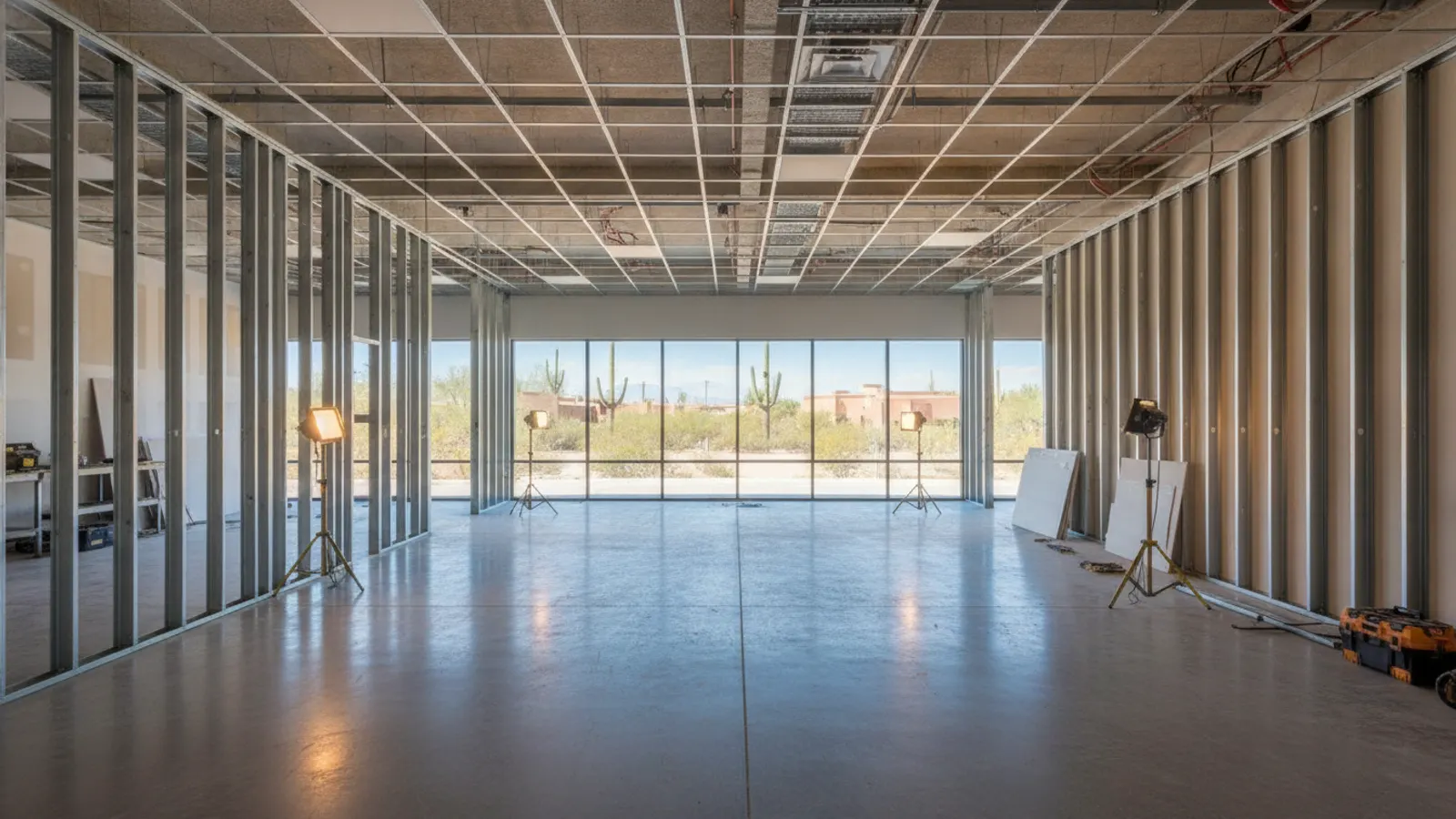
Commercial tenant improvement build-out with metal stud framing and a suspended ceiling grid in a Tempe, Arizona home
Tempe's commercial corridor is the densest in the East Valley — Mill Avenue restaurant and retail TIs in older mid-century buildings, ASU-adjacent office and research-support along Apache and University, and mid-rise Class A office at Tempe Town Lake (Marina Heights, Hayden Ferry, Watermark).
Mill Avenue work routinely involves structural reinforcement of pre-1970 buildings, Type I hood and grease interceptor coordination, and after-hours work to avoid game-day and event-week disruption.
Tempe Town Lake high-rise TIs run Class A specifications with strict after-hours core-drilling and freight-elevator rules.

Why Tempe Commercial Construction Is Different

Mill Avenue: pre-1970 building structural reinforcement, ADHS / Maricopa Environmental on restaurant TI.
Town Lake high-rise: after-hours core drilling and freight-elevator scheduling required.
ASU-adjacent: city plus university coordination on research-support build-outs.
City of Tempe commercial plan review: 4–6 weeks first cycle.

Recent Commercial Construction Projects in Tempe

Mill Avenue

Restaurant TI 4,200 sf in 1948 building, structural reinforcement, Type I hood, grease interceptor

$580K20 weeks

Tempe Town Lake (Marina Heights)

Class A office TI 11,500 sf, demountable walls, AV rough-in, after-hours core drilling

$690K18 weeks

ASU-adjacent (Apache)

Research-support office + small wet-lab TI 5,800 sf, fume-hood rough-in, deionized water

$520K16 weeks

Commercial Construction in Tempe: Fast Facts

Average Tempe commercial TI: $160K–$500K.

Town Lake high-rise after-hours premium: 15–25%.

Mill Avenue restaurant TI: $130–$200/sf.

ASU research-support TI: 2–4 weeks added for university coordination.

Tempe plan review: 4–6 weeks first cycle.

Typical Cost

$25,000 – $1,500,000+

Typical Timeline

1 – 12 months

Permit Lead Time

2–4 weeks

How We Approach Commercial Construction

ProWorx Restoration delivers commercial construction and tenant-improvement work across the Phoenix metro — office buildouts, retail spaces, restaurant TIs, medical and dental offices, and multi-tenant shell modifications. We hold Arizona ROC #349454 and act as the general contractor of record from design coordination through certificate of occupancy.
Commercial work in the Valley carries specific compliance pressure: 2018 IBC with Arizona amendments, 2018 IFC for fire-rated assemblies and sprinklers, Maricopa County Health Department requirements for any food-service buildout, and ADA accessibility standards across every entry, restroom, and circulation path. We pre-coordinate with the landlord's CAM contact, the city plans examiner, and where applicable the fire marshal so submittal comments don't blow up the schedule.

Tenant improvements (TI) for office, retail, medical, dental

Restaurant buildouts including grease, ansul, hood, and Health Dept coordination

Office buildouts with low-voltage, HVAC modifications, and acoustic ceilings

ADA compliance: accessible restrooms, doorways, ramps, parking, signage

Fire-rated demising walls and sprinkler modification coordination

Off-hours and night-shift scheduling to keep tenants operating

What Tempe Homeowners Should Know About Commercial Construction

Building Toward an Opening Date

Commercial tenants often have fixed opening dates tied to leases, marketing or seasonal demand. Construction schedules must account for permitting, long-lead materials, inspections and the time needed for furniture, fixtures and equipment installation. Planning backward from the opening date helps ensure the space is ready on time.

Fire and Life Safety Systems

Commercial buildings often require fire sprinklers, fire alarms, emergency lighting, exit signs and fire-rated construction. Alterations to a space may require modifications to these systems, which must be designed, installed and inspected properly. Coordinating these systems early prevents delays in obtaining occupancy.

Materials & Standards We Use

Construction is per 2018 IBC with Arizona amendments, 2018 IFC, 2018 IMC, 2018 IPC, and the 2018 IECC for energy compliance. Fire-rated assemblies follow UL listings with documented penetration sealing. Restroom plumbing fixtures meet WaterSense flow rates required by the Arizona Energy Code. ADA paths verified against 2010 ADA Standards. All work permitted, inspected, and warrantied under ROC #349454.

Restoring Building Exteriors

The exterior of a commercial building shapes how customers and tenants perceive it, and deteriorated stucco, faded paint, damaged signage and worn finishes can make an otherwise sound property look neglected. Restoring facades, repairing and repainting exterior finishes, replacing damaged trim and updating lighting can significantly improve curb appeal. Beyond appearance, exterior restoration also protects the building envelope from water intrusion and sun damage, which reduces the likelihood of more serious and expensive interior problems developing later.

Matching Historic Materials

Restoring older buildings often requires matching materials that are no longer standard. Historic masonry may need mortar that is softer and more compatible with the original bricks than modern mortar, since harder mortar can damage historic masonry. Older stucco, plaster, wood profiles and windows may need custom work to match. Using compatible materials preserves both the building's appearance and its long-term durability.

Storefronts and Entrances

Storefront glazing, entrance doors and canopies take heavy use and constant exposure to the elements. Failed seals, damaged frames, worn hardware and deteriorated finishes affect both appearance and security. Restoring or replacing storefront systems can improve energy efficiency, curb appeal and accessibility for customers.

Restoring Occupied Buildings

Many buildings must remain in use while restoration takes place. Phasing work, scheduling noisy tasks outside business hours, maintaining safe access, protecting occupants from dust and keeping essential systems operating all require careful planning. Clear communication with occupants reduces disruption.

Rooftop Mechanical Equipment

Commercial buildings frequently house HVAC units on the roof, and the penetrations and curbs supporting them are common leak points. Replacing equipment may require structural evaluation, new curbs and careful flashing. Coordinating roofing and mechanical work avoids damage to new roofing when equipment is replaced.

Commercial Construction Close-Out

Completing a commercial project includes final inspections, obtaining occupancy approval, providing warranty documents, operation manuals and as-built drawings, and resolving any punch-list items. A thorough close-out ensures the owner has the information needed to operate and maintain the space.

Obtaining a Certificate of Occupancy

Before a commercial space can open, it typically must pass final inspections and receive approval for occupancy. Building, fire and other inspections confirm that the work complies with applicable codes. Planning for these final steps helps avoid delays at the end of the project.

Historic Buildings and Preservation Standards

Historic buildings require a different approach from ordinary repairs. Preservation guidance, including the Secretary of the Interior's Standards for the Treatment of Historic Properties, emphasises repairing rather than replacing historic materials where possible and making new work compatible with the original. Properties in historic districts or listed on historic registers may also be subject to review before exterior changes are made.

Accessibility Upgrades

Commercial and public buildings undergoing restoration may need accessibility improvements, such as accessible entrances, restrooms and routes through the building. Planning these upgrades as part of the restoration allows them to be integrated thoughtfully into the building's design.

Common Commercial Construction Issues in Phoenix-Metro Builds

Three items dominate TI schedules. First, fire-marshal review — sprinkler relocations and any change of occupancy class trigger fire department coordination that's often the long pole. Second, Health Department for restaurants: grease interceptor sizing, three-compartment sinks, mop sinks, and ventilation hood specs all need pre-approval. Third, ADA: 2010 ADA Standards apply to every TI, and even a minor restroom modification can trigger a full restroom upgrade if existing conditions weren't compliant. We surface all three during pre-construction so they're budgeted and on the schedule.

How Our Commercial Construction Process Works in Tempe

01

Free On-Site Consultation

We visit your property, discuss your goals, and provide a detailed, no-obligation estimate.

02

Custom Project Plan

Our team creates a tailored project plan with timeline, materials, and transparent pricing.

03

Licensed Crews On Site

Licensed craftsmen complete your project with quality materials and meticulous attention to detail.

04

Final Walkthrough & Sign-Off

We inspect every detail with you and ensure complete satisfaction before the job is done.

"ProWorx worked nights in our Marina Heights tower so our team never lost a day — keys delivered ahead of schedule."

ProWorx Client · Tempe

Neighborhoods We Serve in Tempe

Mill Avenue · Tempe Town Lake · Marina Heights · Downtown Tempe · ASU corridor · Warner Ranch · Lakes · Maple-Ash · Broadmor · South Tempe

Commercial Construction FAQs for Tempe Homeowners

Commercial Construction Guides for Tempe Homeowners

Practical reading from our team before you commit to a project.

Ready to Start Your Tempe Commercial Construction Project?

Get a free, no-obligation estimate from a licensed Arizona contractor — ROC #349454.