



Concrete Pouring in Fountain Hills, AZ

Hillside footings, custom foundations, and decorative concrete across Fountain Hills.

Serving Fountain Hills & nearby Maricopa County

Get Your Free Concrete Pouring Estimate

Step 1 of 5Project

What kind of project?

Pick the option that fits best — you can add details next.

Quick Answer

ProWorx Restoration provides concrete pouring across Fountain Hills, AZ — hillside caisson and grade-beam footings, custom-home foundations, decorative driveways, pool decks, and ordinance-coordinated work in Firerock, Eagle Mountain, and SunRidge Canyon. Typical projects run $9 – $24/sf.

1,200+

Projects Completed

15+

Years Experience

ROC #349454

Licensed & Insured

100%

Satisfaction Guaranteed

Concrete Pouring Built for Fountain Hills Homes
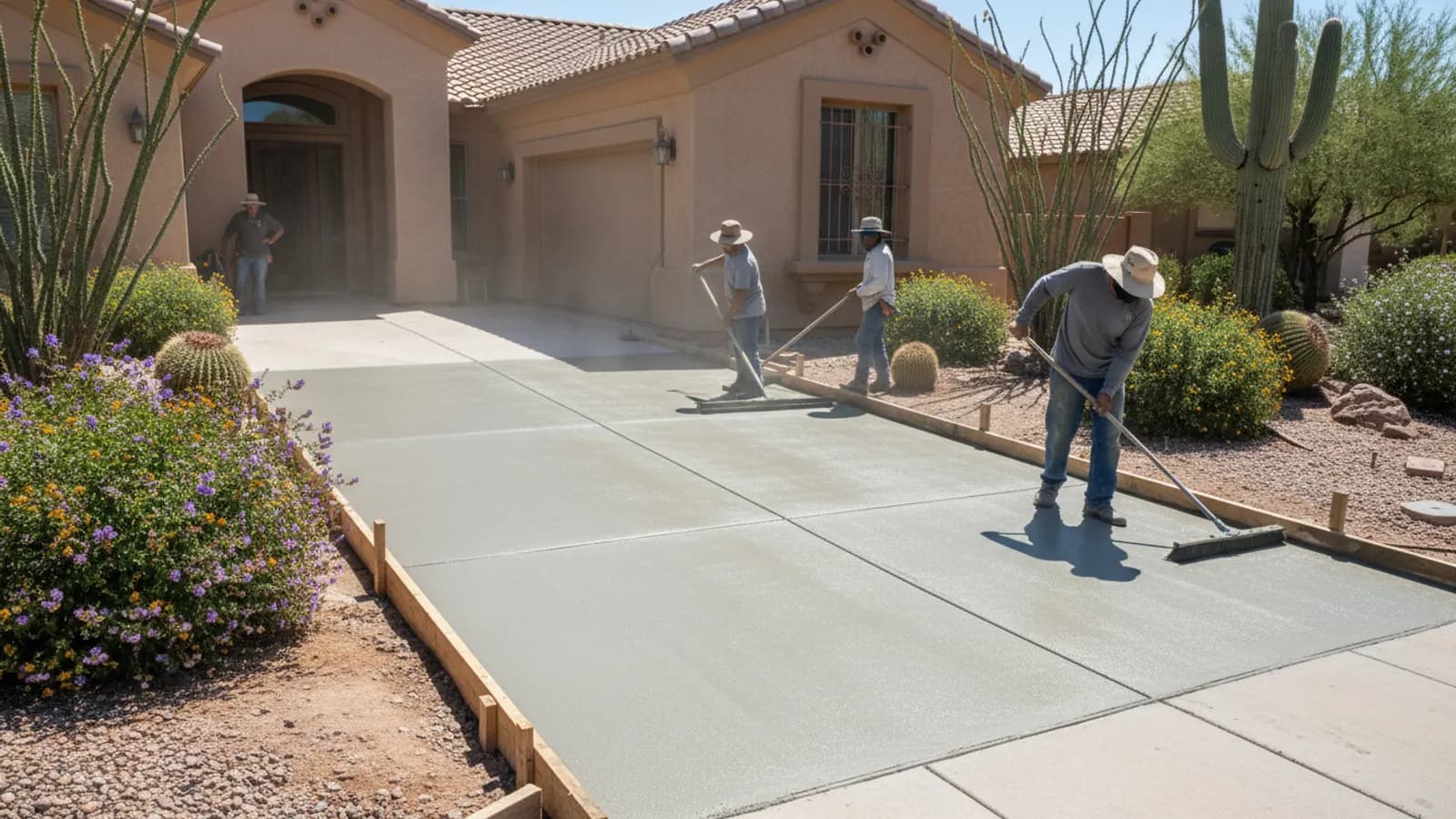
Freshly poured concrete driveway being screeded and floated between forms in a Fountain Hills, Arizona home
Fountain Hills custom homes (Firerock, Eagle Mountain, Adero Canyon) sit on hillside lots requiring caisson and grade-beam footing systems. Town Hillside Ordinance triggers additional review on cut/fill and footings.
Pool deck replacement is steady — older Fountain Hills pools (1990s–2000s) see deck pours on a 15–20 year cycle.
Pre-dawn pour scheduling May–September is standard.

Why Fountain Hills Concrete Pouring Is Different

Town Hillside Ordinance: additional review on cut/fill and footing scope.
Hillside caisson and grade-beam footings: engineered on every custom build.
Town of Fountain Hills permits structural slabs and footings in 2–3 weeks plus hillside review.

Recent Concrete Pouring Projects in Fountain Hills

Firerock

New-build foundation: caissons + grade-beams + 4,200 sf monolithic slab, hillside-engineered

$110K24 days

Eagle Mountain

Pool deck replace 1,100 sf, broom-cool finish, salt accent border

$24K9 days

SunRidge Canyon

Decorative driveway 1,300 sf, stamped slate, integral color, sealed

$30K10 days

Concrete Pouring in Fountain Hills: Fast Facts

Hillside footings / custom foundations: ~40% of Fountain Hills volume.

Pool deck replacement: ~20%.

Decorative driveway / patio: ~25%.

Average Fountain Hills concrete project: $14,000–$90,000.

Hillside ordinance review: standard on custom-home footings.

Typical Cost

$1,500 – $25,000+

Typical Timeline

3 days – 3 weeks

Permit Lead Time

2–4 weeks

How We Approach Concrete Pouring

ProWorx Restoration pours residential and commercial concrete across the Phoenix metro — foundations, driveways, patios, walkways, RV pads, equipment slabs, and decorative finishes. We hold Arizona ROC #349454 and self-perform formwork, reinforcement, placement, and finishing with crews experienced in hot-weather pours.
Pouring concrete in Arizona means working against ACI 305 hot-weather conditions for most of the year. Surface temperatures above 110°F flash-cure the top of a slab before the bottom sets, causing plastic shrinkage cracks. We pour at dawn (often 4–6 AM in summer), use Type II low-alkali cement, ice-chilled water, retarding admixtures, evaporation-reducing aggregates, and wet-cure or curing-compound applications. Expansive clay soils in parts of north Scottsdale, Cave Creek, and the East Valley require engineered subgrade prep and proper joint placement to control inevitable shrinkage.

Foundation slabs: slab-on-grade, monolithic, and post-tension coordination

Driveways and approaches (5–6" thick with #4 rebar at 18" OC)

Patios, walkways, RV pads, equipment and HVAC slabs

Decorative: stamped, exposed aggregate, integral color, broom and salt finishes

Hot-weather pours per ACI 305 with ice, retarders, and dawn placement

Engineered subgrade prep and control-joint layout for expansive soils

What Fountain Hills Homeowners Should Know About Concrete Pouring

Drainage Around Concrete

Concrete should slope to direct water away from the house and avoid pooling. Patios and walkways that slope toward the foundation can send water against the home during storms. Planning drainage carefully protects both the concrete and the structure.

Repointing Mortar Joints

Mortar joints deteriorate over time, becoming cracked, crumbly or recessed. Repointing removes deteriorated mortar to a consistent depth and replaces it with fresh mortar, restoring the joint's strength and weather resistance. The new mortar should be compatible with the existing masonry, and matching colour and joint profile helps the repair blend in.

Spalling Brick and Block

Spalling occurs when the face of a brick or block flakes, chips or breaks away. It is often caused by moisture moving through the masonry, combined with salt crystallisation or temperature changes. Repairing spalled units may involve replacing individual bricks or blocks and addressing the moisture source that caused the damage in the first place.

Scheduling Around Weather

Concrete work is affected by weather, particularly extreme heat and monsoon rain. Pours are typically scheduled early in the day during summer, and heavy rain soon after placement can damage the surface. Flexible scheduling helps ensure the best possible result.

Painting Block Walls

Many block walls are painted or coated to match a home's exterior. Over time, the finish fades and peels in Arizona's sun. Repainting requires cleaning, repairing cracks and using coatings formulated for masonry. A well-applied finish protects the wall and improves its appearance.

Masonry Fireplaces and Chimneys

Masonry fireplaces and chimneys can develop cracked mortar, damaged crowns and deteriorated flues. Since these components affect fire safety, they should be inspected regularly and repaired by professionals. Restoring chimney crowns and mortar joints keeps water out and protects the structure.

Sealing Masonry

Breathable masonry sealers can help reduce water absorption while allowing moisture inside the wall to escape. Sealers are not appropriate for every situation, and non-breathable coatings can trap moisture and cause damage. Choosing the right product depends on the type of masonry and its exposure.

Driveways

A concrete driveway must withstand vehicle loads, heat and occasional heavy rain. Proper subgrade preparation, adequate thickness, reinforcement, control joints and drainage away from the house all contribute to a driveway that lasts for decades.

Choosing the Right Thickness

Slab thickness depends on its use. Walkways and patios carry relatively light loads, while driveways and RV pads must support vehicles and require thicker concrete and appropriate reinforcement. Using the correct thickness prevents premature cracking and failure.

Sealing Concrete

Applying a sealer helps protect concrete from stains, moisture and wear, and can enhance decorative finishes. Sealers need periodic reapplication, especially on surfaces exposed to intense sun and traffic. Choosing a sealer appropriate for the finish and exposure helps maintain the concrete's appearance.

Preparing the Subgrade

The ground beneath concrete must be properly prepared to support the slab evenly. Removing organic material, compacting soil and adding a suitable base layer help prevent settlement and cracking. Poorly prepared ground is one of the most common causes of concrete failure, regardless of how well the concrete itself is placed.

Common Masonry Issues in Phoenix-Metro Properties

Five patterns dominate. Mortar deterioration along south and west elevations from UV and thermal cycling. Step cracking through brick courses from foundation settlement on expansive soils. Brick spalling from moisture entering cracked joints. Efflorescence from sulfate-rich groundwater wicking through CMU site walls. And on 1920s–1960s downtown Phoenix and Mesa brick, hard Portland-cement patches done in the 80s–90s now causing the softer original brick to spall around the patches. Each pattern needs a different repair — we don't apply a universal fix.

Our Concrete Pouring Process in Arizona

Every pour starts with subgrade prep — strip topsoil, compact to 95% Proctor, and place a 4" aggregate base course for driveways and slabs. Forms are set to grade with proper slope for drainage (1/4" per foot minimum on patios). Reinforcement: #4 rebar on 18" centers for driveways, welded wire mesh for patios. Concrete spec: 3,000 psi minimum residential, 3,500–4,000 psi for driveways and structural slabs, Type II low-alkali cement, 4–6% air entrainment. Hot-weather pours use chilled water, retarding admixture, and 4–6 AM placement. Curing follows ACI 308 — wet cure for 7 days or apply ASTM C309 curing compound. Saw-cut control joints within 8–12 hours of placement at 24× slab thickness spacing.

Cracks in Block Walls

Cracks in block walls take different forms. Step cracks that follow the mortar joints diagonally often indicate settlement, while vertical cracks may result from shrinkage or movement. Horizontal cracks can suggest lateral pressure. The width, pattern and whether a crack is growing all help determine the cause and the appropriate repair, which may range from repointing to partial rebuilding.

Our Proven Process

01

Free Consultation

We visit your property, discuss your goals, and provide a detailed, no-obligation estimate.

02

Custom Plan

Our team creates a tailored project plan with timeline, materials, and transparent pricing.

03

Expert Execution

Licensed craftsmen complete your project with quality materials and meticulous attention to detail.

04

Final Walkthrough

We inspect every detail with you and ensure complete satisfaction before the job is done.

"Hillside foundation in Firerock — caissons drilled to bedrock, grade-beams perfect, monolithic slab through 4,200 sq ft. Cleanest pour I've seen."

ProWorx Client · Fountain Hills

Neighborhoods We Serve in Fountain Hills

Firerock · Eagle Mountain · SunRidge Canyon · Crestview · Adero Canyon · Fountain Hills proper

Concrete Pouring FAQs for Fountain Hills Homeowners

Ready to Start Your Fountain Hills Concrete Pouring Project?

Get a free, no-obligation estimate from a licensed Arizona contractor — ROC #349454.