


If you're replacing flooring in your Mesa home, you've likely narrowed your choices to luxury vinyl plank (LVP) or tile. Both are excellent for Arizona's climate — but they serve different needs.
As flooring installation experts, our team at ProWorx Restoration installs both materials daily. Here's an honest comparison.
Luxury Vinyl Plank (LVP) Overview
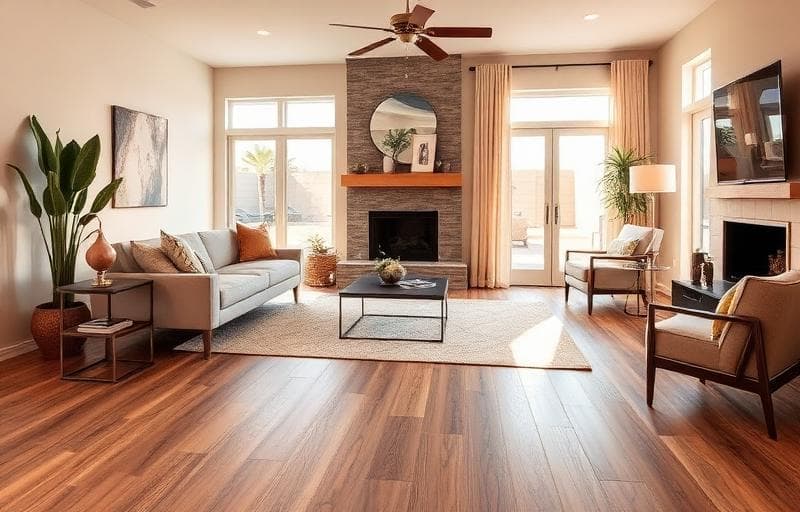
LVP is an engineered flooring product that mimics the look of hardwood or stone. It's made of multiple layers — a wear layer, a printed design layer, and a rigid or flexible core. Modern LVP is virtually indistinguishable from real wood.
Tile Flooring Overview
Porcelain and ceramic tile have been the default Arizona flooring choice for decades. Tile is fired clay — extremely hard, heat-resistant, and waterproof.
Head-to-Head Comparison
- Cost: LVP $3–$7/sq ft installed; Tile $5–$15/sq ft installed
- Durability: Both last 20+ years when properly installed
- Heat transfer: Tile stays cool (great in summer but cold in winter); LVP maintains room temperature
- Comfort underfoot: LVP is significantly softer and more forgiving on joints
- Water resistance: Both are waterproof — ideal for kitchens and bathrooms
- Installation speed: LVP installs 2–3x faster than tile (click-lock vs. mortar and grout)
- Repair: LVP planks can be individually replaced; cracked tiles require more invasive repair
- Resale value: Tile has a slight edge in Arizona's market, though premium LVP is increasingly accepted
Which Is Better for Arizona's Desert Climate?
Both perform well, but consider these Arizona-specific factors:
- Extreme heat: Tile stays cooler in summer — a major comfort advantage when indoor temps can spike before AC catches up
- Monsoon humidity: Both handle moisture well, but LVP's click-lock seams can allow moisture underneath if flooding occurs
- Sand and grit: Desert dust tracks inside constantly — both materials resist scratching, but LVP's softer surface shows wear patterns sooner in high-traffic areas
- Radiant heating: If you add under-floor heating for winter comfort, tile conducts heat more efficiently than LVP
Best Rooms for Each Material
- LVP: Bedrooms, family rooms, hallways, home offices
- Tile: Kitchens, bathrooms, entryways, laundry rooms, patios
- Either: Living rooms, dining rooms
For a broader look at all your options, check our complete Mesa flooring guide.
Can You Mix LVP and Tile in the Same Home?
Absolutely — and most Mesa homes do. A common approach is tile in wet areas (kitchen, bathrooms, laundry) and LVP in living spaces and bedrooms. Modern transition strips create clean lines between materials.
Get Expert Flooring Installation in Mesa
ProWorx Restoration provides professional flooring installation for both LVP and tile across Mesa and the Phoenix Metro area. We help you select the right material for each room and deliver flawless installation.
Schedule your free flooring consultation today.
The Two Default Choices in Arizona
In most Arizona homes the realistic flooring decision comes down to porcelain tile or luxury vinyl plank. Carpet has retreated to bedrooms, solid hardwood struggles with slab installation and very low humidity, and both remaining options handle dust, spills and heat far better than the alternatives.
They are genuinely different products with different failure modes, so the right answer depends on which trade-offs matter in your household rather than on which is objectively better.
Heat: Tile Wins Clearly
Tile stays noticeably cooler underfoot than any other flooring, which is a real comfort advantage for half the Arizona year. It does not absorb and hold heat the way softer materials do, and in homes without carpet people notice the difference walking barefoot in July.
Luxury vinyl sits closer to room temperature. That makes it warmer and more pleasant in winter but removes the cooling effect that many Arizona homeowners specifically want.
Water: Both Perform, Differently
Porcelain tile is effectively impervious, and properly installed over a suitable substrate it tolerates standing water indefinitely. Grout is the weaker element, absorbing stains if unsealed, though the tile itself is unaffected.
Luxury vinyl with a waterproof core also handles spills well, but water can reach the subfloor through seams in a prolonged flood, and the core can be affected if water sits beneath it for a long period. For a mopped spill both are fine; for a burst supply line tile is more forgiving.
Comfort and Noise
Here luxury vinyl has the clear advantage. It is softer and quieter underfoot, more forgiving to stand on while cooking, and considerably more comfortable for anyone with joint problems. Dropped dishes and glasses are far more likely to survive.
Tile is hard. Anti-fatigue mats at the sink and hob help in kitchens, and rugs soften living areas, but the fundamental hardness remains.
Durability and Dust
Arizona dust is abrasive, and it is the main wear mechanism on flooring here. Porcelain tile is extremely hard and essentially unaffected by grit over decades. Its vulnerability is impact: heavy objects can chip or crack a tile, and replacing one cleanly requires having kept spares.
Luxury vinyl resists impact well and does not crack, but the wear layer can scratch under grit, pet claws and dragged furniture. Wear layer thickness is the specification that matters most, and thin budget products disappoint quickly in this environment.
Installation and the Slab Beneath
Both require a flat, clean, dry slab, but tile is less forgiving. Large-format tile in particular demands a very flat substrate, or edges sit proud of one another, a defect called lippage that is obvious under raking light.
Luxury vinyl tolerates minor variation better and installs faster, usually as a floating floor. It still needs proper expansion gaps at the perimeter, because these floors move with the significant temperature swings an Arizona house experiences.
Cost Over Time
Luxury vinyl is generally less expensive to buy and considerably less expensive to install, since it goes down faster and requires less substrate preparation. Tile costs more in both material and labour, particularly with large formats or patterns.
Over a long horizon the gap narrows. Good tile can last the life of the house, while luxury vinyl will eventually need replacing as the wear layer gives out. Which calculation matters depends on how long you intend to stay.
Repair and Replacement
A damaged tile can be removed and replaced individually, provided matching tile is available, which is why keeping spare boxes from the original installation is worth the storage space. Dye lots change and discontinued lines disappear.
Luxury vinyl planks in the middle of a floating floor are harder to replace individually, though click-lock systems allow it with care. Glue-down products are more difficult still.
Choosing Room by Room
Many Arizona households sensibly use both: tile in entries, kitchens, laundry rooms and bathrooms where water and heat matter most, and luxury vinyl through living areas and hallways for comfort and quiet.
If you do mix them, plan the transitions during design so floor heights match and the junction looks deliberate. Running one material through all connected living space makes a home feel larger, so the decision about where to switch deserves thought rather than defaulting to doorways.
Resale Perception
Buyer perception differs from technical performance. Tile is still widely read as the premium, permanent choice in Arizona, particularly porcelain in large formats, and it rarely counts against a home.
Luxury vinyl has gained acceptance substantially as quality has improved, and good product installed well presents nicely. Cheap, thin vinyl with obvious repeating patterns does read as budget, which is another argument for specifying wear layer and quality rather than shopping on price alone.
Pets, Children and Real Households
With pets, luxury vinyl's scratch resistance depends heavily on wear layer thickness, while tile is essentially immune to claws. Both clean easily after accidents, though grout can stain if a spill sits, and pet urine reaching a seam in vinyl can affect the subfloor beneath.
With young children, vinyl's softness is a genuine advantage for falls and for dropped crockery. Tile's hardness is unforgiving in both respects. Many households resolve this by zoning: tile where water and heat dominate, vinyl where people spend time on the floor.