


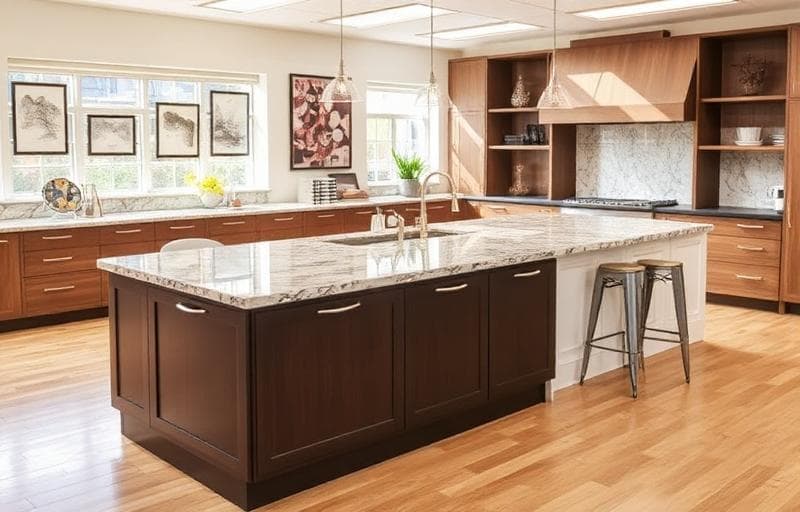
Choosing the right countertop material is one of the biggest decisions in a kitchen remodel. In Mesa, the two most popular options are granite and quartz — and each has distinct advantages depending on your lifestyle, budget, and design goals.
What Is Granite?
Granite is a natural stone quarried from the earth. Each slab is unique, with natural variations in color, veining, and pattern. It's been the premium countertop choice for decades and remains popular in Arizona homes.
ProWorx Restoration offers professional granite countertop installation with a wide selection of colors and edge profiles.
What Is Quartz?
Quartz countertops are engineered stone — roughly 90% ground quartz mixed with resins and pigments. This manufacturing process creates consistent patterns and colors that natural stone can't replicate.
Side-by-Side Comparison
Here's how granite and quartz compare across the factors that matter most to Mesa homeowners:
- Cost: Granite $40–$100/sq ft installed; Quartz $50–$120/sq ft installed
- Durability: Both excellent — granite is harder but quartz is more flexible
- Heat resistance: Granite wins — it handles hot pans directly. Quartz can discolor from extreme heat
- Maintenance: Quartz wins — never needs sealing. Granite requires annual sealing
- Stain resistance: Quartz wins — non-porous surface repels stains completely
- Appearance: Granite offers natural uniqueness; quartz offers consistent, designer patterns
Which Is Better for Arizona's Climate?
Mesa's dry heat and hard water create specific considerations:
- Hard water staining: Quartz resists Mesa's mineral-heavy water better than unsealed granite
- Heat from outdoor kitchens: Granite performs better for outdoor installations exposed to direct sun
- Indoor kitchens: Both perform equally well in climate-controlled environments
For most indoor kitchen countertop installations, quartz is the preferred choice among our Mesa clients in 2026.
What About Other Countertop Materials?
While granite and quartz dominate, some homeowners consider alternatives:
- Butcher block: Warm, natural look but requires significant maintenance in Arizona's dry climate
- Concrete: Industrial aesthetic — pairs well with modern desert homes
- Laminate: Budget-friendly at $10–$30/sq ft but doesn't add the same home value
How to Choose the Right Countertop
Consider these questions:
- Do you cook frequently with hot pans? → Consider granite
- Do you prefer zero maintenance? → Choose quartz
- Is this an outdoor kitchen? → Granite is the safer bet
- Do you want a specific consistent pattern? → Quartz offers more control
Read more about kitchen remodel trends in Mesa for 2026 to see what other homeowners are choosing.
Get Expert Countertop Installation in Mesa
ProWorx Restoration handles the entire process — from helping you select the right material to precise fabrication and installation. We're a licensed general contractor (ROC #349454) with extensive experience in kitchen remodeling across Mesa and the Phoenix Metro area.
Schedule your free consultation and let's find the perfect countertop for your kitchen.
They Are Fundamentally Different Materials
The comparison is often framed as two similar stones, but they are not the same category. Granite is natural igneous rock, quarried in slabs, made of visible interlocking mineral crystals. Quartz countertops are engineered: ground natural quartz bound with resins and pigments, manufactured to a controlled specification.
That difference explains nearly every practical distinction between them. Granite varies because nature made it; quartz is consistent because a factory did.
Appearance and Consistency
With granite, no two slabs are identical, and even slabs cut from the same block differ. For many homeowners that uniqueness is the appeal, and a dramatic slab becomes the focal point of the kitchen. The corollary is that a showroom sample only approximates what you will receive, which is why selecting the actual slabs matters.
Quartz delivers predictability. What you see in the sample is very close to what arrives, patterns repeat consistently across slabs, and matching across seams is far easier. Modern quartz imitates marble convincingly, giving the look without marble's fragility.
Sealing and Maintenance
This is where the practical difference shows up day to day. Quartz is non-porous and never needs sealing. Granite is porous to varying degrees and benefits from periodic sealing, though some dense granites need it rarely.
The water-drop test settles it for any particular stone: place a few drops on the surface and wait several minutes. If the water beads and the stone beneath does not darken, the seal is working. If it soaks in and darkens, it is time to reseal.
Heat Resistance Favours Granite
Granite handles heat better. It formed under extreme temperature and tolerates a hot pan placed directly on it, though sudden extreme thermal shock is still unwise.
Quartz contains polymer resins, and those resins can scorch, discolour or in severe cases crack under direct high heat. Trivets are genuinely necessary with quartz rather than merely advisable. In a household where pans regularly come off the hob onto the counter, this matters.
Scratches, Chips and Stains
Both are hard and resist everyday scratching well, though cutting boards should be used with either, as much to protect knives as the surface. Both can chip at edges and sink cut-outs under heavy impact, and both can usually be repaired with colour-matched resin.
For staining, quartz has the advantage, being non-porous. Unsealed or poorly sealed granite can absorb oil, wine and other liquids. Properly sealed granite performs well, but it depends on maintenance that quartz does not require.
Ultraviolet Light and Arizona Windows
This consideration is more relevant in Mesa than in most markets. Some quartz products can discolour over long periods of direct sunlight, which is why many manufacturers do not warrant them for outdoor use.
If your kitchen has large west or south-facing windows admitting hours of direct sun onto the counter, or you are considering an outdoor kitchen, natural granite is generally the safer choice. For a typical interior installation, it is rarely an issue.
Cost
The ranges overlap substantially. Common granites and standard quartz colours sit at similar price points, while exotic granites with dramatic patterning and premium designer quartz both rise sharply.
Total cost also depends on square footage, number of seams, edge profile, cut-outs and installation complexity. Natural stone can require buying more slab than strictly needed if the layout produces awkward waste, which is worth asking about when comparing quotes.
Which Suits Which Household
Granite suits people who want a one-of-a-kind natural surface, cook with hot pans frequently, have strong direct sunlight on the counters, and do not mind occasional sealing.
Quartz suits people who want predictable appearance, prefer no maintenance, are matching a specific design scheme, want easy seam matching on a large island, or are less confident about keeping up with sealing. Neither is better; they fail in different directions, and the right question is which trade-off fits your kitchen.
Edges, Thickness and Seams
Both materials come in standard thicknesses, and the choice affects appearance and cost. Thicker slabs look more substantial and span further without support; thinner material reads sleeker and can cost less, with edges sometimes built up to appear thicker.
Edge profiles range from simple eased or square edges through bullnose and ogee. More elaborate profiles cost more in fabrication time. Seam placement matters on both materials but shows more on patterned granite, where matching veining across the joint takes skill. Reviewing the seam plan before fabrication is worth doing with either material.
Cleaning and Daily Care
Both are straightforward, with one important caution. Avoid harsh chemicals, bleach, ammonia and abrasive pads on either: they dull quartz resins and strip sealer from granite. Warm water with mild dish soap handles routine cleaning, with a stone-specific cleaner for periodic deeper cleaning.
In Mesa, hard water adds a wrinkle. Mineral deposits form around faucets and in low spots on either material, and wiping the surface dry after use prevents the spotting that otherwise needs an acidic cleaner to remove, which is itself unsuitable for some stones.