If your home just flooded, the first question is almost always: how long until my life goes back to normal? Here's an honest, day-by-day timeline for water damage restoration in Phoenix — what happens, when, and what makes it faster or slower.
How Long Water Damage Restoration Takes in Phoenix
- Clean water (Category 1): 3 – 5 days dry-out, 1 – 2 weeks total
- Grey water (Category 2): 4 – 7 days dry-out, 2 – 3 weeks total
- Black water / sewage (Category 3): 7 – 14 days dry-out, 3 – 6 weeks total
The 5 Phases of Water Damage Restoration
Phase 1: Emergency Response (Hours 0–4)
A qualified Phoenix restoration crew should be on-site within 60–90 minutes. They'll stop the water source, document damage for insurance, and start extraction.
Phase 2: Water Extraction (Day 1)
Truck-mounted extractors pull standing water from floors, carpet pad, and subfloor. Same-day extraction is critical — every hour that water sits raises the chance of mold and structural damage.
Phase 3: Drying & Dehumidification (Days 2–7)
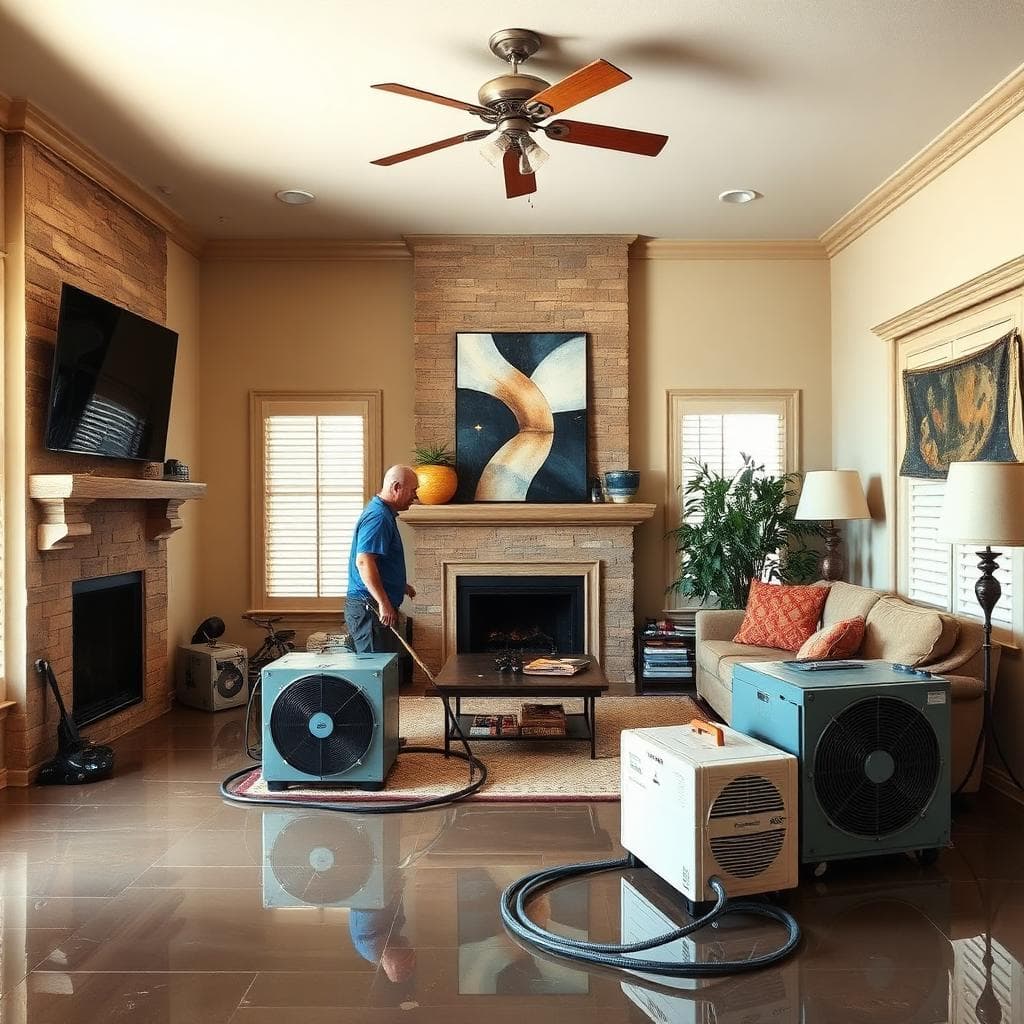
Industrial air movers and LGR dehumidifiers run continuously. Phoenix's dry climate helps, but interior moisture pockets behind drywall and under tile still need 3–7 days. Daily moisture readings confirm progress.
Phase 4: Demolition & Cleaning (Days 5–10)
Anything that can't be dried — saturated drywall, carpet pad, swollen cabinets — comes out. The space is sanitized and treated for mold if needed.
Phase 5: Rebuild (Days 10–30+)
Drywall, paint, flooring, baseboard, and cabinets go back in. A licensed general contractor like ProWorx handles the rebuild end-to-end, so you're not juggling subcontractors.
What Slows Things Down
- Insurance approval delays — adjusters can take 3–10 days to authorize scope
- Hardwood floors — drying takes 2–3x longer than carpet or LVP
- Hidden moisture — found behind walls or under slabs after demo starts
- Asbestos or lead testing — required for homes built before 1980
What Speeds Things Up
Calling within the first 24 hours, choosing a contractor who handles both restoration and rebuild, and approving scope quickly. Watch for the warning signs of hidden water damage so you catch leaks early next time.
Need Help Right Now?
ProWorx offers 24/7 emergency water damage response across Phoenix, Mesa, Gilbert, and Chandler. Call us or request an emergency dispatch and we'll be on-site within 90 minutes.
The Honest Answer Is: It Depends on Four Things
Homeowners want a number, and the honest answer is that four variables determine it: how much water there was, how far it spread, how long it sat before mitigation started, and what materials it reached.
A clean-water leak caught within hours in a tiled room may be dried in a few days. The same volume of water sitting for a week under carpet and into drywall becomes a demolition and rebuild measured in weeks. The variable most within your control is the third one.
Mitigation and Reconstruction Are Separate Phases
Much of the confusion about timelines comes from conflating two different phases. Mitigation is the emergency work: stopping the source, extracting water, removing unsalvageable materials and drying the structure. Reconstruction is putting the house back: drywall, flooring, cabinetry, paint.
Mitigation typically runs three to five days. Reconstruction depends entirely on how much was removed and can range from a few days to several weeks, plus any wait for insurance approval and material lead times.
Why Drying Usually Takes Three to Five Days
Drying is not about surface dryness. It is about returning the moisture content of materials, including framing and subfloor, to a normal level measured against unaffected materials of the same type elsewhere in the house.
That takes days because moisture has to migrate out of dense materials, and equipment placement, air movement and dehumidification have to work together. Readings are taken daily, and equipment stays until the numbers match the dry standard rather than until a set number of days has passed.
Arizona's Dry Air Helps, the Heat Complicates
Phoenix's low humidity is genuinely an advantage: dehumidifiers work against a lower ambient moisture load than in a humid climate, and drying is often faster here than the same loss would be elsewhere.
Summer heat cuts both ways. Warm air holds more moisture, which helps evaporation, but a house running air conditioning while drying equipment runs creates a conflict, and equipment adds heat and noise to a home that is already warm. Crews manage this, but it affects how the house feels during the work.
What Makes It Take Longer
Several factors reliably extend a job. Contaminated water requires more removal and cleaning rather than drying in place. Water trapped under cabinets, behind walls or beneath hardwood needs specialised equipment and more time. Large affected areas take longer simply because there is more to dry.
Delay before mitigation is the most consequential. Water that sat long enough for microbial growth adds remediation to the scope, which adds containment, additional removal and verification.
Why Drying Equipment Must Stay Running
The equipment is noisy, raises the temperature and is inconvenient, and homeowners frequently want to switch it off at night. Doing so lets moisture redistribute and effectively restarts the drying clock.
Running continuously is what shortens the overall job. Turning equipment off to sleep more comfortably typically adds days, and in Phoenix's climate those extra days can be the difference between drying materials in place and replacing them.
The Insurance Timeline Runs Alongside
The claim has its own schedule that does not always align with the work. Mitigation should begin immediately regardless, because most policies require reasonable steps to prevent further damage, and waiting for an adjuster to visit before extracting water is both unnecessary and harmful.
Reconstruction is where claims cause delay, because scope and pricing must be agreed. Thorough documentation during mitigation, including daily moisture readings and photographs, is what keeps that part moving.
Can You Live in the House?
Often yes, depending on what was affected. Drying equipment is loud, raises room temperature and may seal off areas. If the kitchen or the only bathroom is out of service, or if contaminated water or mould is involved, staying elsewhere is usually more practical.
Many policies include additional living expenses when a home is uninhabitable, so it is worth asking your adjuster early rather than assuming you must stay.
A Realistic Overall Picture
For a straightforward residential water loss caught quickly, expect roughly three to five days of drying, then reconstruction proportional to what was removed, commonly one to three weeks for a single room.
Larger losses, contaminated water, mould remediation or significant structural repair extend that considerably. A contractor should give you a specific estimate after assessing your situation and update it as the work progresses rather than quoting a general rule.
What Happens on Day One
Understanding the first day makes the overall timeline less opaque. A crew arrives, makes the property safe, confirms the water source is stopped, and assesses the extent using moisture meters and thermal imaging to find water that is not visible.
They then extract standing water, remove materials that cannot be dried such as saturated carpet pad and affected drywall, and set drying equipment sized to the space and the amount of water absorbed. Documentation and photographs are produced throughout, because the insurance claim depends on them as much as the drying does.
Why You Cannot Rush Drying
The pressure to finish quickly is understandable, but drying is a physical process that takes the time it takes. Moisture has to migrate out of dense materials, and removing equipment early leaves moisture inside walls and under floors where it causes mould and secondary damage weeks later.
Anyone declaring a structure dry without producing moisture readings is guessing. The readings are what justify removing the equipment, and they are also what protects you if a problem emerges afterwards, because they document the condition the house was left in.