Our Drywall Installation Process in Arizona
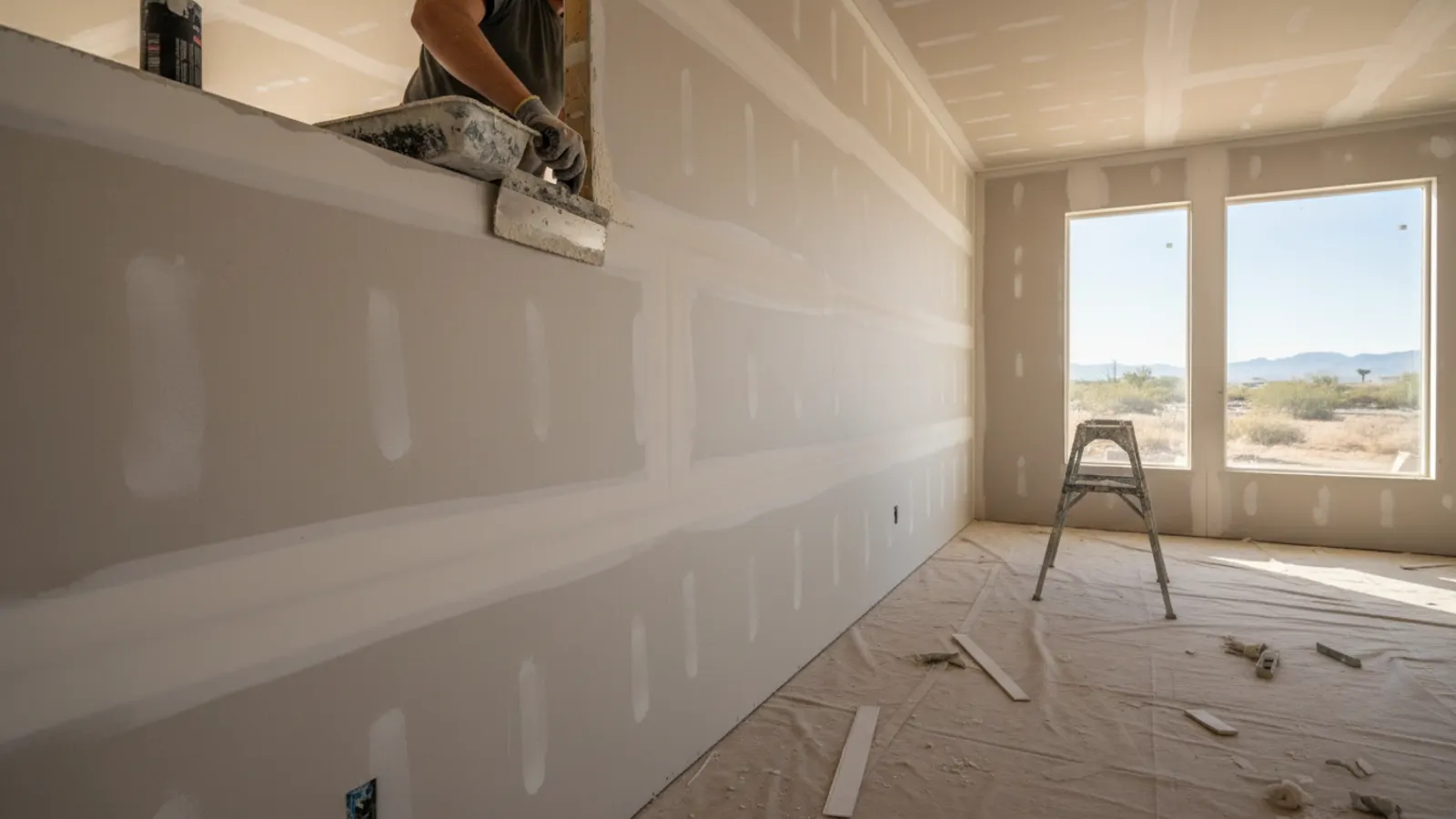
Hang sequence starts with ceilings, then walls top-to-bottom with butt joints staggered. Fastener spacing per GA-216 — 16" OC on ceilings, 16"–24" OC on walls. All joints taped with paper tape (not mesh on butt joints) bedded in setting-type mud. Three coats minimum, sanded between coats. Primer is shellac-based for any smoke- or water-stained substrate and PVA elsewhere. Texture is applied with calibrated hopper or air-driven gun — we test on cardboard against your existing wall sample to dial in match before spraying. Single-room scope: 3–5 days. Whole-home or full reconstruction: 2–4 weeks.
Common Drywall Issues in Phoenix-Metro Homes
Texture mismatch is the #1 failure on amateur work — raking light from low-angle Arizona afternoon sun makes every imperfect patch visible. Nail and screw pops are common on 1990s–2000s tract homes from seasonal humidity swings; we re-secure and refinish. Water-stained ceilings from monsoon leaks or upstairs bathroom failures need full-sheet replacement once paper face is compromised — surface paint over a wet stain re-bleeds within weeks. Bathroom drywall around showers should be moisture-resistant board (purple board), not standard sheetrock; replacing with the right material prevents future mold.
Materials & Standards We Use
Installation per GA-216 (Gypsum Association Application & Finishing). Sheet sizes: 1/2" regular for walls, 5/8" Type X for ceilings and garage walls per IRC fire requirements. Joint compound: setting-type for first two coats, lightweight all-purpose for finish coat. Tape: paper for tapered joints, fiberglass mesh only on small patches. Finish levels per GA-214 — Level 4 standard, Level 5 skim coat for areas with critical light or semi-gloss/gloss paint. All work warrantied under ROC #349454.
Choosing the Right Drywall
Drywall comes in different types for different locations. Standard drywall suits most walls and ceilings. Moisture-resistant board is used in areas exposed to humidity, though tile in wet areas requires a proper tile backer. Fire-resistant drywall is used where codes require fire separation, such as between an attached garage and living spaces. Choosing the right type ensures safety and performance.
Drywall Thickness
Drywall is available in several thicknesses. Thicker panels resist sagging on ceilings, provide better sound control and are used in fire-rated assemblies. Thinner panels may be used for curved walls or overlays. The appropriate thickness depends on the location and code requirements.
Levels of Drywall Finish
Drywall finishing is described in levels, from the minimal finish used in areas that will not be seen, up to the highest level, which includes a skim coat over the entire surface for a perfectly smooth result. Areas with critical lighting, glossy paint or smooth finishes require higher finish levels so imperfections do not show.
Wall Textures in Arizona Homes
Many Arizona homes feature textured walls rather than smooth finishes. Knockdown and orange peel textures are common, and they help disguise minor imperfections. Matching existing textures during repairs requires skill and experience.
Patching Holes and Damage
Small holes from nails or minor impacts can be filled and sanded, while larger holes require a drywall patch secured to backing or framing. Proper patching techniques ensure repairs are strong and invisible after texturing and painting.
Nail Pops and Screw Pops
Small bumps or circles appearing on walls and ceilings are often caused by fasteners working loose as framing shrinks or moves. Resetting the fastener, adding a new one nearby and refinishing the area usually resolves the problem.
Cracks at Corners and Seams
Cracks often appear at inside corners, along seams or above doors and windows where movement concentrates. Some cracking is caused by normal settling, while recurring cracks may indicate structural movement or improper installation. Properly repairing and reinforcing seams helps prevent recurrence.
Corner Bead
Outside corners are protected with corner bead, which creates a straight edge and resists impact damage. Damaged or dented corner bead can be replaced or repaired to restore a clean edge.
Sound Control
Additional insulation, resilient channels, specialised sound-dampening drywall and careful sealing can reduce noise transmission between rooms. These options are useful for bedrooms, home offices and media rooms.
Drywall After Water Damage
Drywall that has been soaked by water often loses strength and may support mould growth. Saturated drywall is usually cut out and replaced after the wall cavity has been dried. Replacing damaged sections promptly prevents further deterioration.
Drywall and Electrical or Plumbing Changes
When electrical or plumbing work requires opening walls, drywall must be replaced and finished afterward. Coordinating these trades so walls are opened only once saves time and cost.
Installing Drywall on Ceilings
Ceiling drywall is heavier and more difficult to install than wall drywall, and it is more prone to sagging over time if fastened incorrectly. Using the correct thickness, fastener spacing and framing support ensures ceilings remain flat. Ceilings are typically hung before walls so wall panels support the ceiling edges, creating stronger corners.
Garage Drywall and Fire Separation
Building codes require fire-resistant construction between an attached garage and the living space, and drywall is a key part of that separation. Using the correct drywall type and sealing penetrations properly maintains the fire barrier. Any openings or damage to garage walls and ceilings should be repaired to preserve this protection.
Painting New Drywall
New drywall must be primed before painting, because the paper surface and joint compound absorb paint differently. Without primer, the finished wall may show uneven sheen or visible seams. A quality primer creates a uniform surface so the topcoat looks consistent.
Moisture-Resistant Board in Humid Areas
Laundry rooms, bathrooms and areas near water heaters benefit from moisture-resistant drywall, which better tolerates humidity than standard board. It is not waterproof, however, and should not be used as a tile backer in showers or tub surrounds, where cement board or another approved backer is required to protect the wall assembly.
Drywall in Additions and Remodels
In additions and remodels, new drywall must blend with existing walls. Matching thickness at transitions, feathering joints carefully and replicating the existing texture ensure new walls look continuous with the rest of the home rather than standing out as obvious new work.